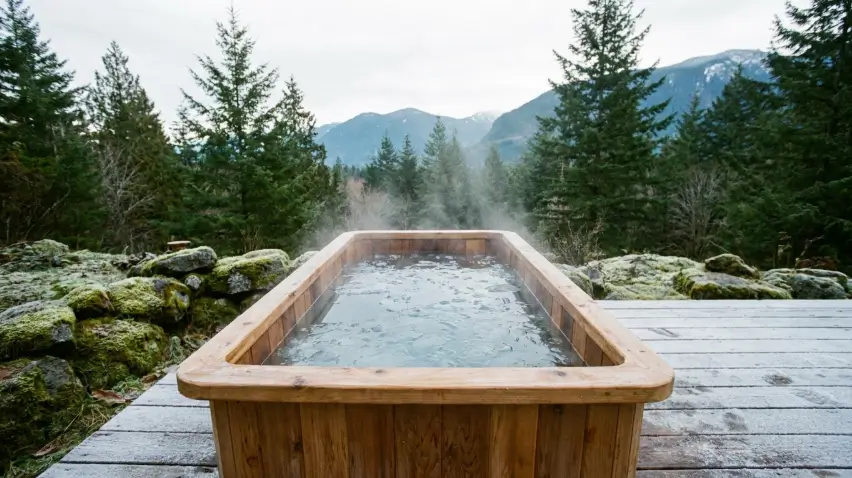
Most home cold plunges are set between 39 and 55 degrees Fahrenheit, with sessions running two to four minutes at the colder end and up to eight or ten minutes for anyone starting warmer. In an apartment, condo, or small backyard where one tub serves an entire household, a simple rotation, a rinse-off habit, and a fitted cover between uses matter just as much as the temperature dial. The rest comes down to building tolerance slowly and picking a session length that fits the routine actually in place, not a number borrowed from someone else’s setup.
What Temperature Should You Actually Set It To?
Thirty-nine to 55 degrees Fahrenheit covers the range most manufacturers build their chillers around, and where a specific unit lands inside that window usually comes down to tolerance rather than a fixed rule. New users generally start closer to 50 or 55 degrees for the first few sessions, since jumping straight to the low 40s before the body has any exposure history tends to trigger a sharp gasp reflex and a shortened, panicked session rather than a controlled soak. Lowering the setpoint by two or three degrees every week or two, once the warmer setting feels routine, is a more sustainable path to colder water than dropping the temperature all at once. In a small space where the tub sits close to a bedroom or living area, most chillers cycle on and off to hold a setpoint rather than running constantly, so the actual water temperature drifts a degree or two between cycles even at one consistent setting.
How Long Should a Session Last?
Two to four minutes is a reasonable target for a full-body soak once the water sits in the low to mid 40s, short enough that a household sharing one tub can realistically fit two or three people through a morning routine before work. At warmer settings, in the low 50s, sessions commonly stretch to six, eight, or occasionally ten minutes, since the body loses heat more slowly across a smaller temperature gradient. Watching for shivering that will not stop, numbness spreading past the hands and feet, or confusion are better stopping cues than a fixed clock, since cold tolerance varies enough between people that a timer alone can miss a real warning sign. For a shared small-space plunge, agreeing on a rough session length in advance, even a loose one, keeps one person’s extended soak from turning into a long wait for the next.
Building Up Tolerance Without Overdoing It
Tolerance to cold water immersion builds gradually with repeated, modest exposure rather than through one dramatic first session. Starting at the warmer end of the range, around 55 degrees, for 60 to 90 seconds and adding time or lowering the temperature only after several sessions feel manageable is slower but more sustainable than pushing straight to a target number seen online. Skipping sessions for a week or two does not erase all progress, though tolerance built over a month of consistent use fades faster than it built if the routine stops entirely. Anyone with a cardiovascular condition, uncontrolled blood pressure, or who is pregnant should treat new cold exposure as something to raise with a doctor before starting, since the vasoconstriction cold water triggers is a real physiological event, not just a sensation.
Timing Sessions Around Workouts and the Day
Cold plunging after a workout, rather than before, is the more common pattern, since entering cold water immediately before strength training can leave muscles less responsive and slower to warm back up for lifting. Some people build a plunge into a morning routine instead, using it mainly for the alertness a sudden temperature drop produces rather than pairing it with exercise at all. Evening sessions are less common, since that same alertness effect can interfere with falling asleep for some people, though this varies enough that it is worth testing on a weekend rather than assuming either direction. In a household with more than one user, a simple rule, such as morning slots on weekdays and flexible timing on weekends, avoids the scheduling friction that tends to shorten how long a shared plunge actually gets used.
Etiquette Rules for a Shared, Small-Space Plunge
A quick rinse before stepping in keeps sweat, sunscreen, and lotion residue out of a tub holding a relatively small, standing volume of water compared with a full-size pool. A fitted cover between sessions cuts down on dust and debris in an outdoor or garage setup and helps a chiller hold its setpoint by reducing heat gain from open air. In a household sharing one unit, a short posted schedule or a simple group text avoids the awkward overlap of two people wanting the tub at once in a small bathroom or balcony footprint. Filtration or an ozone system running continuously between uses, rather than only during a session, does more to keep water clear over a week of shared use than any single person’s rinse habit alone.
What to Look for When Buying for a Tight Footprint
Interior depth is the single most important number for anyone shopping with limited space, since a tub deep enough to cover the torso while seated, typically 28 to 34 inches, delivers a very different experience than a shallow model marketed mainly on price. Chiller clearance, usually 18 to 24 inches of open air on at least two sides, is easy to forget when measuring only the tub itself, and boxing a chiller into a tight cabinet without airflow shortens its working life. Retailers such as SweatDecks list interior dimensions and chiller clearance together on the product page, which makes it easier to check whether a specific model will actually clear a bathroom doorway or a condo balcony gate before ordering rather than after delivery. Weight matters too: a filled tub in the 90 to 120 gallon range can exceed 800 pounds once a person steps in, so the floor or deck underneath needs to be level and load rated, not just flat looking.
What the Research Says About Cold-Water Immersion
The evidence behind cold water immersion is thinner and more mixed than most marketing copy suggests. A 2025 systematic review and meta-analysis published in PLoS One, evaluating cold water immersion’s effects on health and wellbeing broadly, found modest and inconsistent support across the outcomes it examined, a useful reminder that many benefits associated with cold plunging are not yet backed by strong, consistent evidence. A 2023 meta-analysis in Frontiers in Physiology, looking specifically at cold water immersion after exercise, found it associated with improved perceived recovery and reduced fatigue in some contexts, though effects on objective performance measures were less consistent across the pooled studies. An earlier 2012 Cochrane review focused narrowly on muscle soreness found some supportive evidence that cold water immersion reduces soreness after exercise compared with rest alone, while noting the certainty of that evidence was limited by small trial sizes. None of this amounts to proof that cold plunging causes a specific outcome, and it is fairer to describe these as associations worth knowing than guarantees.
Frequently Asked Questions
What temperature should a home cold plunge be set to?
Most home units run between 39 and 55 degrees Fahrenheit. Beginners typically start near the warmer end and lower the setting gradually over several weeks.
How long should a cold plunge session last?
Two to four minutes covers most full-body sessions at colder settings, while sessions at the warmer end of the range can stretch to eight or ten minutes.
How do you keep a small shared plunge sanitary between users?
A quick rinse before entering, a fitted cover between sessions, and continuous filtration or ozone treatment all help in a small, shared volume of water.
Is it better to cold plunge before or after a workout?
After is more common, since immersing before strength training can leave muscles cold and less responsive. Some people plunge in the morning instead, separate from exercise.
References
- “Effects of cold-water immersion on health and wellbeing: A systematic review and meta-analysis.” PLoS One, 2025. https://pubmed.ncbi.nlm.nih.gov/39879231/
- “Effects of cold water immersion after exercise on fatigue recovery and exercise performance: meta analysis.” Frontiers in Physiology, 2023. https://pubmed.ncbi.nlm.nih.gov/36744038/
- “Cold-water immersion (cryotherapy) for preventing and treating muscle soreness after exercise.” Cochrane Database of Systematic Reviews, 2012. https://pubmed.ncbi.nlm.nih.gov/22336838/
By Diane Marsh